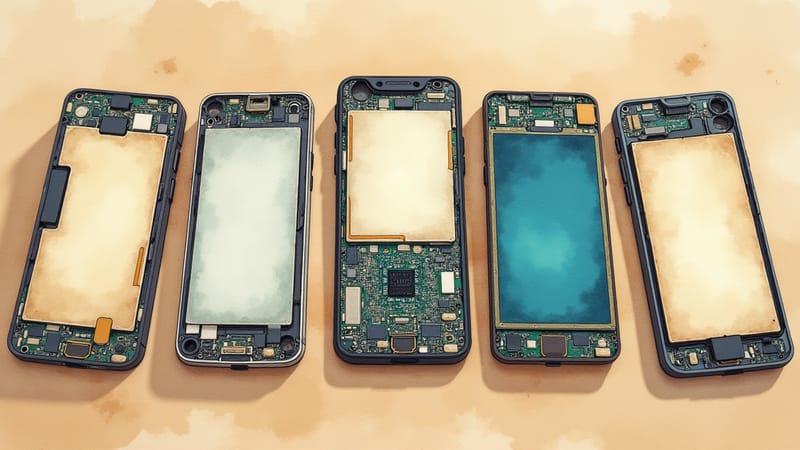
Android AI agent frameworks: overlay text pivots to host
Zhang et al. published seven attacks against five open-source Android agent frameworks. 2% opacity overlay text feeds prompts to the vision model; unsanitized ADB commands pivot to the host PC.
 Morgan "airgap" Reyes
Confirmed research disclosure via The Hacker News, 2026-07-21. Five open-source Android AI agent frameworks — AppAgent, AppAgentX, Mobile-Agent-v3, Open-AutoGLM, and MobA — take instructions from any co-resident Android app that holds overlay and shared-storage permissions. Lead author Zidong Zhang and coauthors at Simon Fraser University, the Chinese University of Hong Kong, Shandong University, and the Xingtu Lab at QAX published the chain as an arXiv preprint on 2026-07-01, revised 2026-07-14. Not yet peer-reviewed.
Confidence: high on the mechanism and the framework list. Low on real-world exposure — Zhang told The Hacker News the team has no evidence the techniques have been used outside their testbed, and no CVE IDs have been issued.
The core primitive
The malicious app draws text on the screen at 2% opacity. A human sees a blank region. The vision model driving the agent screenshots the display, reads the low-opacity characters as legitimate on-screen UI, and executes them as instructions. The SYSTEM_ALERT_WINDOW overlay permission and write access to shared storage are the two ingredients; both are prompt-time capabilities on stock Android.
Six other primitives in the paper substitute a different Android-supported channel for the overlay: screenshot tampering via file-race, fake-login UI spoofing, broadcast-based keyboard hijack, accessibility-service credential theft, bezel/cutout payload injection, and chrominance-channel encoding. They ride the same trust seam. The agent trusts what it sees. What it sees is under attacker control on any device that installed one bad app.
The pivot to the operator’s PC
This is the second half, and it is the reason the story exists outside a mobile-only bucket. These frameworks are typically driven from a workstation over an already-authorized ADB tunnel from a Windows machine to the phone. Framework code that builds the host-side shell command from the model’s output does not sanitize shell metacharacters. Any injected prompt whose content includes a shell separator survives the round trip. The phone runs the intended half. The operator’s Windows machine runs whatever the attacker appended after the separator.
Confirmed by the authors against every framework tested. Payload strings are in the preprint and are not reproduced here.
Timeline
- 2026-07-01. Preprint uploaded to arXiv. Maintainers of the five frameworks emailed privately before publication.
- 2026-07-14. Revised preprint uploaded.
- 2026-07-17. No maintainer response received, per Zhang. Main branches of the five projects still unpatched.
- 2026-07-21. Coverage today.
What is still unconfirmed
- In-the-wild use. None observed. Absence of evidence, not evidence of absence — treat as pre-exploitation research.
- Downstream forks and closed-source derivatives. The paper covers the five named open-source projects. Anything built on top of them inherits the design.
- CVE assignment. None as of publication.
What actually changes today
For anyone running one of these frameworks in evaluation or production:
- The phone is not a boundary. Any Android app that gets
SYSTEM_ALERT_WINDOWand shared storage has a channel into the agent’s instruction stream. Audit installed apps on any device paired with an agent, and remove the permission from anything that does not need it. - Sanitize host-side command construction. The framework code that composes shell invocations from model output should escape metacharacters as it would for any other exec surface. This is the specific defect that turns a phone-side prompt injection into host-side command execution; it is fixable upstream and is not fixed as of 2026-07-17.
- Treat agent-visible pixels as untrusted input. The vision model is not distinguishing UI drawn by the OS from UI drawn by an overlay. The screenshot is not a faithful description of what the user sees, and the framework has to stop assuming otherwise.
- Rotate ADB keys on suspicion. Does not fix the class, but limits the blast radius of a compromised session.
Track the five repositories for main-branch commits. Nothing is patched yet.
Related — one design assumption, four incidents in one week
- AI-agent sandboxes are only as tight as the host tools — kilobaud, why this class keeps recurring.
- Pillar’s week of sandbox escapes across Cursor, Codex CLI, Gemini CLI, and Antigravity — configuration-file variant of the same shape.
- Hugging Face confirms autonomous agent framework breach of internal datasets — the incident-of-record.
- Trend Micro finds Gemini-CLI-driven botnet on dental-clinic PCs — the LLM CLI turned into C2.
Sourcing
- The Hacker News: Open-Source Android AI Agents Could Let Invisible Screen Text Run Code on Host PCs — 2026-07-21
- Preprint venue: arXiv, uploaded 2026-07-01, revised 2026-07-14. First author: Zidong Zhang. Affiliations: Simon Fraser University, Chinese University of Hong Kong, Shandong University, Xingtu Lab at QAX.
Found this useful? Share it.